When a leading Western hospital tells you, “This case is too complex — we’ve done everything we can,” at Shanghai Ninth People’s Hospital, that is often where treatment begins, not where it ends. As Asia’s largest and highest-ranked center for plastic surgery and oral-maxillofacial medicine, Shanghai Ninth draws patients from over 80 countries annually. Backed by five Chinese Academy of Engineering academicians, more than 120,000 surgeries per year, and treatment costs that run one-third to one-fifth of Western equivalents, it has rewritten the ending for countless cases once deemed hopeless.
Whether you need congenital craniofacial deformity correction, advanced oral cancer resection with one-stage functional reconstruction, 3D-printed custom joint replacement, or high-success-rate IVF, this guide delivers objective, granular, and decision-ready information — covering departmental strengths, surgeon credentials, real international patient cases, cost comparisons, and the practical pathway from inquiry to treatment.
Hospital Overview: A Century of Excellence, Asia’s Benchmark
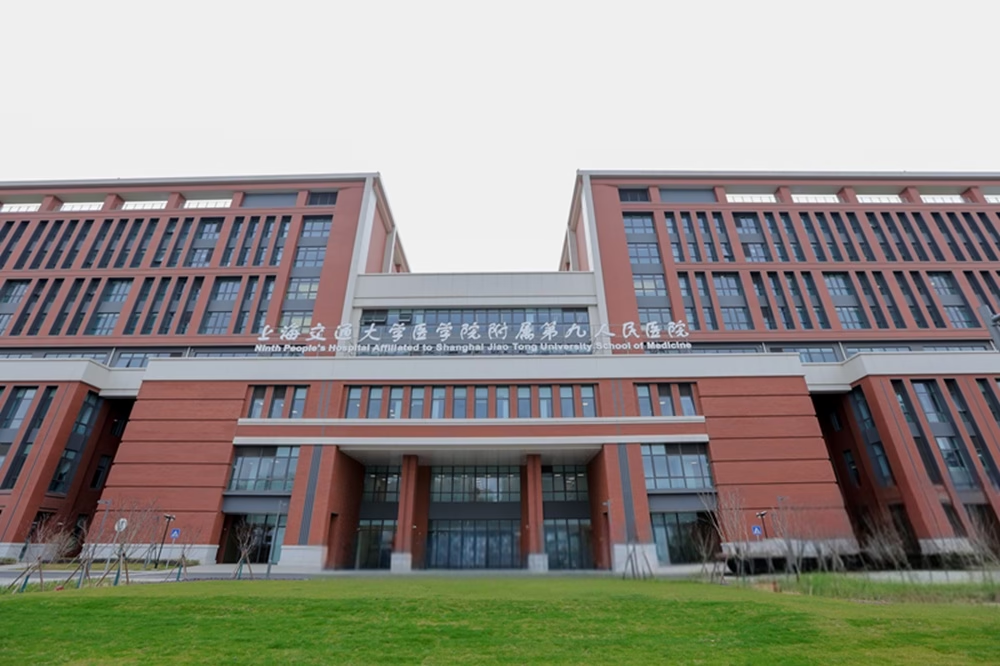
Shanghai Ninth People’s Hospital, fully affiliated with Shanghai Jiao Tong University School of Medicine (Shanghai Ninth for short), is a Grade A Tertiary hospital — China’s highest hospital classification — and one of the most influential centers for plastic surgery and stomatology in Asia. Its roots trace back to the Bethel Hospital founded in 1920. It received its current name in 1952, was integrated into Shanghai Jiao Tong University School of Medicine in 2005, and completed a major resource merger with the former Shanghai Third People’s Hospital in 2014 — three transformative leaps across a century that built the institution you see today.
In March 2026, Shanghai Ninth’s Eastern Campus officially opened in Zhuqiao Town, Pudong New Area, serving as the core facility for the National Stomatology Medical Center. The new campus spans 222,000 square meters of floor space, with 800 planned inpatient beds and 700 dental treatment chairs — a single-facility scale that ranks among the world’s largest for stomatology. Across all campuses, Shanghai Ninth now covers 259.7 mu (approx. 17.3 hectares), with a total built area of 451,000 square meters, 2,600 approved beds, and over 1,000 dental chairs.
The numbers tell a compelling story: in 2025, outpatient and emergency visits exceeded 4.8 million, inpatient surgeries surpassed 90,000, and the average length of stay was just 4.6 days. Sustaining this level of efficiency at such massive volume is, in itself, a testament to the hospital’s operational and clinical maturity.
Shanghai Ninth brings together five academicians of the Chinese Academy of Engineering, with three flagship disciplines — stomatology, reconstructive and plastic surgery, and orthopedics — complemented by ophthalmology, otorhinolaryngology-head and neck surgery, assisted reproduction, and interventional medicine. Reconstructive surgery was founded by Academician Zhang Disheng, the father of Chinese plastic surgery; oral-maxillofacial surgery was pioneered by Academician Qiu Weiliu. Both disciplines have consistently held the No. 1 national ranking in their respective specialties. These rankings are not mere labels — they reflect the clinical judgment and technical confidence forged through tens of thousands of complex cases each year.
World-Class Clinical Expertise: What Shanghai Ninth Treats Best
With over 120,000 surgical procedures annually — including more than 60,000 combined in plastic and oral-maxillofacial surgery — Shanghai Ninth manages one of the highest proportions of complex, high-acuity cases among Chinese hospitals. Here is a closer look at each core department’s real data, technical advantages, and ideal patient profile:
Reconstructive & Plastic Surgery: A Global Pinnacle of Repair and Rebuilding
Over 50,000 outpatient visits and more than 100,000 surgeries annually — by volume alone, this places the department among the world’s busiest plastic surgery centers. But volume is not the story. The real differentiator is a singular focus on cases that others have declared inoperable:
- Congenital Craniofacial Deformity Correction: Including severe craniosynostosis, orbital hypertelorism, and hemifacial microsomia. Cleft lip and palate repair success rate: 98.5%. Postoperative functional recovery rate for severe craniofacial deformities: >95% — figures routinely cited at international congresses.
- Organ Reconstruction (Ear / Nose / Breast): Not merely “creating a shape,” but full-spectrum reconstruction from function to aesthetics, using microvascular free flap techniques with internationally leading flap survival rates.
- Post-Burn Scar Reconstruction: For extensive scar contracture and functional impairment following major burns, employing pre-fabricated flaps, tissue expanders, and free flap transfer protocols.
- Microvascular Free Flap Transplantation: Harvesting tissue with its blood supply from one part of the body and precisely transferring it to the defect site — the “technical ceiling” of reconstructive surgery. Shanghai Ninth performs thousands of such procedures each year.
Ideal patient profile: Congenital anomalies, severe post-traumatic facial or body defects, burn scar contractures, and post-mastectomy reconstruction candidates.
Oral & Maxillofacial Surgery: Asia’s Hub for Oral Cancer Treatment and Functional Restoration
Over 800,000 annual outpatient visits, 50,000+ surgeries per year (including 12,000+ oral cancer surgeries), 80,000+ dental implant procedures, and 100,000+ orthodontic visits — these numbers represent China’s largest oral disease diagnosis and treatment system.
- Comprehensive Oral Cancer Treatment: Pioneered the “radical tumor resection + one-stage functional reconstruction” model. Historically, oral cancer surgery meant “cut to save life, lose the function.” Shanghai Ninth’s philosophy is to address both cure and reconstruction in a single procedure. Five-year oral cancer survival rate: >65%, substantially above global averages.
- Dental Implants: With 80,000+ cases annually, the surgical team has encountered virtually every imaginable alveolar bone condition — from single-tooth immediate placement to full-arch All-on-4 rehabilitation. Protocols are mature, and complication rates are low.
- Orthodontics: 100,000 cases per year spanning the full spectrum from adolescent traditional braces to adult clear aligner therapy.
Ideal patient profile: Oral cancer patients, maxillofacial tumor patients, edentulous patients seeking implants, and malocclusion candidates for orthodontic treatment.
Orthopedics | Ophthalmology | Assisted Reproduction: A Multi-Disciplinary Cluster Led by Academicians
- Orthopedics: 3,000+ joint replacements annually. Academician Dai Kerong’s team pioneered the clinical application of 3D-printed patient-specific artificial joints and implants in China. The department has distinctive protocols for revision arthroplasty and bone defect reconstruction.
- Ophthalmology: Academician Fan Xianqun’s team has built a digital orbital surgery platform with endoscopic navigation, taking a national lead in ocular tumors and orbital diseases. AI-assisted early screening systems for ocular tumors have markedly improved detection rates.
- Assisted Reproduction: Over 10,000 IVF egg-retrieval cycles per year with a clinical pregnancy rate consistently above 55%. The team of Kuang Yanping and Lyu Qifeng specializes in third-generation IVF (PGT), recurrent implantation failure, and premature ovarian insufficiency — drawing a substantial international patient base from the Middle East and Southeast Asia.
The Expert Team: Five Academicians at the Helm
Housing five Chinese Academy of Engineering academicians under one roof is rare anywhere in the world. More importantly, these are not “nameplate academicians” — they are the founding architects of their disciplines, still deeply engaged in clinical work:
- Academician Zhang Disheng — Father of Chinese reconstructive and plastic surgery. He built the complete discipline from trauma repair to organ reconstruction. His clinical philosophy continues to guide the department’s treatment pathways today.
- Academician Qiu Weiliu — Founder of oral-maxillofacial surgery in China. He was the first to systematically articulate the concept of functional oral cancer surgery, establishing Shanghai Ninth’s global standing in this field.
- Academician Dai Kerong — Orthopedic and biomaterials pioneer. He led the introduction of 3D printing into orthopedic clinical practice, enabling the revolutionary shift from “standard” to “custom” joint implants.
- Academician Zhang Zhiyuan — Authority in oral-maxillofacial head and neck oncology. His team performs one of the highest annual volumes of oral cancer surgeries worldwide.
- Academician Fan Xianqun — Ophthalmology and orbital disease specialist. He developed the digital orbital surgery framework, transforming orbital tumor surgery from “blind-sphere operation” into “navigation-guided precision resection.”
Frontline Key Surgeons:
- Professor Li Qingfeng (Director of Reconstructive & Plastic Surgery, Hospital President): Changjiang Distinguished Professor. Personally performed over 8,000 complex reconstructive surgeries, specializing in severe post-burn repair, craniofacial reconstruction, and autologous organ/tissue reconstruction. Serves as an executive committee member of the International Society of Aesthetic Plastic Surgery (ISAPS) — one of the highest international academic posts held by a Chinese plastic surgeon.
- Professor Wang Wei (Reconstructive & Plastic Surgery): A pioneer of microsurgery and tissue transplantation in China. Former President of the Chinese Medical Association’s Plastic Surgery Division. He has trained generations of reconstructive surgery leaders.
- Kuang Yanping & Lyu Qifeng Team (Assisted Reproduction): Specializing in PGT (third-generation IVF), recurrent implantation failure, and premature ovarian insufficiency. They have successfully helped hundreds of families from the Middle East and Southeast Asia achieve pregnancy.
Landmark International Cases: Real Stories, Verifiable Results
The cases below have been published in leading international journals and validated through peer review. They are not marketing copy — they are verifiable academic records:
- UAE Royal Family Member — Full Facial Reconstruction (2024): The patient sustained massive comminuted facial defects in a severe car accident and was told by multiple Western medical centers that reconstruction was impossible. Professor Li Qingfeng’s team used a staged approach combining 3D-printed titanium mesh with autologous tissue transplantation to complete total facial rebuilding. The surgical protocol was published in Plastic and Reconstructive Surgery (journal website).
- Russian Child with Crouzon Syndrome (2023): A young patient from Russia with Crouzon Syndrome faced severe craniofacial deformity affecting both appearance and neurological development. Shanghai Ninth performed digitally-assisted craniofacial reshaping surgery that significantly improved cranial morphology and neurological function. The case has been cited as a reference standard by the International Society of Craniofacial Surgery.
- Kazakhstan — Total Facial Burn Reconstruction (2023): A patient with extensive post-burn total facial destruction and severe functional impairment. The team employed staged tissue-expander implantation combined with microsurgical free flap transfer to achieve high-difficulty total facial reconstruction — the first procedure of its kind performed in China for a Central Asian patient, establishing a referral benchmark for Belt and Road countries.
- Indonesian Senior Official — Advanced Oral Squamous Cell Carcinoma (2025): Extended resection + free fibula flap mandibular reconstruction + postoperative radiotherapy achieved “oncologic cure with mandibular function preservation.” At two-year follow-up, no recurrence; the patient eats and speaks normally.
- Gulf States — Assisted Reproduction (2022–2025): Over 200 infertile couples from the UAE, Saudi Arabia, and Qatar have been treated cumulatively. The majority achieved pregnancy within 1–2 treatment cycles. Shanghai Ninth’s PGT capability enables chromosomal screening that substantially improves success rates for patients of advanced maternal age or with recurrent failure.
Frontier Research & Innovation: Why Shanghai Ninth Keeps Leading
Shanghai Ninth is more than a surgical hospital — it is a core engine of medical-engineering convergence and digital surgery in China. Research output flows directly into clinical technique, forming a rapid “research → technology → surgery” feedback loop:
- Tissue Engineering & Regenerative Medicine: Home to the National Engineering Research Center for Tissue Engineering. In 2025, the team developed 3D-bioprinted living skin for extensive burn patients, reducing healing time by 40% and scarring by 60%. Published in Science Translational Medicine (journal website). The Cao Yilin team’s tissue-engineered cartilage and bone research remains in the global top tier.
- Digital Medicine & 3D Printing: Under the Ministry of Education’s Digital Medicine Engineering Research Center, 3D-printed implants and virtual surgical planning are now routinely applied in orthopedic and craniofacial procedures. Related digital surgery research has been published in Nature Communications (journal website) — signaling recognition at the highest academic level.
- AI-Assisted Diagnosis: The oral cancer early-screening AI system achieves >95% accuracy. The ophthalmology AI significantly boosts early detection rates for ocular tumors. Both systems are being deployed across Belt and Road countries, extending premium diagnostic capability beyond borders.
- Novel Biomaterials: The independently developed biodegradable magnesium-alloy bone plate — no secondary removal surgery required after fracture healing — has received China’s Class III medical device registration. Stem cell exosome-based wound repair research was published in Cell Reports Medicine (journal website).
- Surgical Robotics: Da Vinci robot-assisted oral-maxillofacial and microsurgical procedures have demonstrated 50% reduction in blood loss and significantly shorter hospital stays, particularly valuable for precision dissection in delicate surgeries.
International Patient Services: Full Journey Support
Shanghai Ninth’s International Medical Department provides end-to-end coordination — from the moment you are still weighing treatment options in your home country to remote follow-up after you return:
- Multilingual Support: 50+ professional coordinators provide full-journey interpretation in English, Japanese, Korean, Arabic, Russian, and Indonesian, and can produce foreign-language medical records and itemized billing compliant with international insurer requirements.
- Fast-Track Access: International patients complete outpatient consultation and diagnostic workup within 48 hours; emergency and severe cases are scheduled for surgery within 72 hours — a stark contrast to the weeks-or-months waiting lists common in Western hospitals. Pre-arrival digital assessment can be performed remotely with imaging data submitted in advance.
- Direct Insurance Billing: Direct-pay agreements with 40+ international insurers covering the US, European, Middle Eastern, and Southeast Asian markets. Patients avoid large upfront out-of-pocket payments.
- Reference Pricing (in RMB): Cleft lip/palate repair ≈¥25,000 (US equivalent ≈¥105,000); maxillofacial free flap reconstruction ¥80,000–120,000 (US equivalent ≈¥700,000); single IVF cycle ¥40,000–60,000. Overall savings vs. Western equivalents: 60%–80%. Note: these are reference ranges; actual costs vary by clinical complexity and implant/material selection, to be confirmed at consultation.
- Postoperative Follow-Up: IoT-enabled remote monitoring plus 12 months of video-based follow-up consultations. Bilateral referral pathways can be established with the patient’s home-country healthcare institution to ensure continuity of care.
International Patient FAQ
Q: I don’t speak Chinese. How do I navigate treatment at Shanghai Ninth?
A: The International Medical Department has 50+ multilingual coordinators covering English, Japanese, Korean, Arabic, Russian, and Indonesian. From initial inquiry through postoperative follow-up, an interpreter accompanies you at every step. Medical documentation can be issued in foreign languages.
Q: How do I book an appointment with a specialist? How long is the wait?
A: Initiate contact through the International Medical Department at +86-21-2327-1699 or international@sh9hospital.com. International patients typically complete outpatient arrangements within 48 hours — substantially faster than standard registration channels.
Q: What about Chinese visa requirements? How long do I need to stay?
A: Most short-term treatments (single surgery, diagnostic evaluation) can be accommodated on a tourist visa (L visa). For complex, multi-stage treatment (staged surgeries, full IVF cycles), the hospital can issue an invitation letter to support an S2 visa application. We recommend confirming your visa pathway with the coordinator at the initial inquiry stage.
Q: Can I use my international health insurance at Shanghai Ninth?
A: Shanghai Ninth has direct billing agreements with 40+ international insurers. Even if your insurer is not on the direct-pay list, the hospital provides English-language itemized billing, diagnostic reports, and operative records that meet international claims standards, enabling you to file for reimbursement upon returning home.
Q: How can I verify the quality of care? Does the hospital hold international accreditation?
A: Shanghai Ninth is a Grade A Tertiary hospital — China’s highest classification — led by five Chinese Academy of Engineering academicians. Reconstructive surgery and oral-maxillofacial surgery have consistently ranked No. 1 nationally. The hospital’s clinical research has been published in Science Translational Medicine, Nature Communications, Plastic and Reconstructive Surgery, and other top-tier international journals — quality that has been validated by global peer review.
Q: What if I have complications after returning to my home country?
A: Shanghai Ninth provides 12 months of complimentary video-based follow-up consultations and can supply IoT remote monitoring devices to track key indicators. Where needed, the hospital can establish a bilateral referral channel with a healthcare provider in your home country.
Global Influence & Academic Collaboration Network
Shanghai Ninth’s impact extends well beyond its operating rooms. It has built a globally radiating network of teaching, research, and clinical collaboration:
- Global Training Hub: Hosts 200+ visiting physicians from Belt and Road countries annually, with cumulative overseas healthcare professional training exceeding 3,000. Telemedicine consultation nodes have been established in Cambodia, Laos, Indonesia, and Saudi Arabia, extending expert diagnostic opinion to local patients.
- International Academic Leadership: Faculty members hold executive or presidential roles in ICOPLAST (International Confederation for Plastic, Reconstructive & Aesthetic Surgery), the World Oral Cancer Alliance, and the Asia-Pacific Craniofacial Association — directly contributing to international treatment guideline formulation.
- Top-Tier Academic Partnerships: Long-term joint research programs and physician exchange mechanisms with Harvard Medical School, Johns Hopkins Hospital, Massachusetts General Hospital, and Tokyo Medical and Dental University — ensuring the clinical perspective remains synchronized with the global frontier.
- National Mission: Undertakes China’s foreign medical aid missions and supports specialty capacity-building in underserved regions through initiatives such as the Shanghai-Hainan collaboration program.
Why Shanghai Ninth: A Rational Decision Checklist
We understand that traveling abroad for major surgery is one of life’s weightiest decisions. The checklist below presents the key considerations — in facts, not rhetoric:
- Five academicians actively directing clinical disciplines: Not retired figureheads — deeply involved in complex case discussions and departmental strategy. The sustained No. 1 national rankings for reconstructive surgery and oral-maxillofacial surgery are the outcome.
- Specialization in “abandoned” cases: Complex craniofacial deformities, advanced oral cancers, and extensive post-burn sequelae deemed untreatable by leading Western centers are, quite literally, Shanghai Ninth’s daily caseload.
- Research-to-clinic speed: From 3D-printed custom implants to AI-assisted early screening, from biodegradable biomaterials to Da Vinci robotics — at Shanghai Ninth, research output is not a publication; it is a tool deployed in the operating room the next day.
- Manageable costs: Total treatment cost runs approximately one-third to one-fifth of Western equivalents. Direct international insurance billing eliminates the need for large upfront cash payments.
- Remarkable efficiency: International patients complete diagnostic workup and consultation within 48 hours; urgent/severe cases are scheduled for surgery within 72 hours — no months-long waiting lists.
- Shanghai’s locational advantage: Direct flights from two international airports. No need for connecting flights to remote cities. World-class urban amenities support your stay during treatment.
If you are facing any of the following, Shanghai Ninth merits priority consideration: congenital craniofacial deformities, complex oral-maxillofacial tumors, extensive post-traumatic reconstruction, or high-difficulty cases that other hospitals have deemed inoperable or unlikely to succeed.
Contact Information
- International Medical Department: +86-21-2327-1699 (multilingual: English, Japanese, Arabic, Russian, etc.)
- Email: international@sh9hospital.com
- South Campus: No. 639 Zhizaoju Road, Huangpu District, Shanghai
- East Campus: No. 99 Yunting Road, Zhuqiao Town, Pudong New Area, Shanghai (National Stomatology Medical Center)
- Official Website: https://www.9hospital.com.cn (English version available)
- Official Patient Guide: https://www.9hospital.com.cn/list/11/guide.html
Disclaimer: This article is provided for medical tourism informational purposes only and does not constitute professional medical advice or a substitute for clinical consultation. International patients should independently verify hospital, physician, and treatment plan information and consult qualified healthcare professionals before making treatment decisions. MedChinaGuide.com assumes no liability for any medical decisions made based on the content herein.
Authoritative Journal Links Referenced in Patient Cases
- Plastic and Reconstructive Surgery (journal publishing the UAE facial reconstruction case): http://journals.lww.com/plasreconsurg/pages/default.aspx
- Science Translational Medicine (journal publishing the 3D-bioprinted skin study): https://www.science.org/journal/stm
- Nature Communications (journal publishing digital surgery research): https://www.nature.com/ncomms
- Cell Reports Medicine (journal publishing stem cell exosome research): https://www.cell.com/cell-reports-medicine