Core Insight: For Canadian tax residents working, living, or visiting family in China, out-of-pocket medical expenses paid to legitimate medical institutions can be claimed for the Medical Expense Tax Credit (METC) with the Canada Revenue Agency (CRA). This is not a “loophole”—it is a clear CRA regulation. This guide combines official policies to provide you with an accurate, actionable roadmap to legally reduce your net medical costs.
Breaking the Myth: Medical Care in China = Double Savings
Many Canadian expats and travelers assume that seeing a doctor in China only saves them the difference in treatment costs. In reality, a portion of these expenses can be effectively “reimbursed” through your year-end tax return!
According to the CRA, eligible medical expenses can be claimed as a non-refundable tax credit to reduce your taxable income. As long as you retain valid receipts, these expenses are generally claimable regardless of where in the world (including China) the service was rendered.
CRA Policy Core: Overseas Medical Expenses are Tax-Deductible
The CRA explicitly states that the claim for the Medical Expense Tax Credit (METC) is not limited to expenses incurred within Canada.
Key Provision: The CRA states, “Generally, you can claim the total amount of eligible medical expenses paid, even if they were not paid in Canada.”
To claim, three conditions must be met simultaneously:
- Payer Status: You are a Canadian tax resident paying for yourself, your spouse, or eligible dependents.
- Service Provider: The medical service is provided by a licensed medical practitioner or legitimate medical institution in China (e.g., public hospitals, international departments, or compliant private clinics).
- Net Out-of-Pocket Amount: You can only claim the portion you actually paid and which has not been reimbursed by any insurance plan (including travel insurance or Chinese social insurance).
Which Medical Expenses in China are Claimable?
As long as they are provided by a qualified practitioner, the following out-of-pocket expenses incurred in China are generally claimable:
Generally Claimable Items:
- Diagnostic Services: Outpatient fees, hospitalization, surgery, anesthesia.
- Diagnostic Tests: X-rays, CT scans, MRIs, ultrasounds, lab work, etc.
- Dental Services: Exams, cleaning, fillings, root canals, extractions, crowns, dentures, and medically necessary orthodontics.
- Prescription Drugs: Medication prescribed by a doctor and dispensed by a hospital or registered pharmacy (prescription and itemized receipt required).
- Specific Therapies:
- Acupuncture: Provided by a licensed medical practitioner registered under Chinese law.
- Physiotherapy, Chiropractic services, etc.
- Vision Care: Eye exams, optometry, prescription glasses/contact lenses, laser eye surgery (e.g., LASIK, requires medical certification).
- Necessary Equipment: Wheelchairs, walkers, crutches, etc. (usually requires a doctor’s recommendation).
Generally Non-Claimable Items:
- Cosmetic surgery or dental procedures purely for aesthetic purposes (e.g., teeth whitening).
- Over-the-counter drugs, health supplements, vitamins (unless prescribed by a doctor for a specific medical condition).
- Travel, accommodation, and meal expenses not directly related to medical treatment.

How is the Tax Credit Calculated? How Much Can You Save?
The METC is a non-refundable tax credit that saves you money by directly reducing the tax you owe. It does not create a refund on its own but lowers your payable tax.
Calculation Formula:
Eligible Claim Amount = Total Eligible Medical Expenses − Deduction Threshold
Estimated Federal Tax Savings ≈ Eligible Claim Amount × Lowest Federal Tax Rate (15%)
(Note: Provincial medical expense tax credits also apply, offering further provincial tax savings.)
Deduction Threshold: The lower of:
- 3% of your net income for the tax year.
- The CRA’s fixed annual minimum amount ($2,834 for the 2025 tax year).
Example:
Ms. Zhang is a Canadian tax resident with a net income of $70,000 in 2025. She paid $8,000 CAD (equivalent) for dental treatment at a Shanghai hospital.
- Threshold: 70,000 × 3% = 2,100 (Lower than the fixed limit of 2,834, so the threshold is 2,100).
- Eligible Claim Amount: 8,000 – 2,100 = $5,900.
- Federal Tax Savings: 5,900 × 15% = $885.
- Provincial Tax Savings: Varies by province. For example, in Ontario (rate 5.05%), she saves an additional ~$298.
- Total Tax Savings: Approximately $1,183 CAD (based on Ontario rates; rates vary by province).
Optimization Strategy: Due to the threshold, it is advisable for the family member with the lower net income to claim the total medical expenses for the whole family (self, spouse, minor children) to maximize the credit.
Keys to Success: Preparing CRA-Compliant Documentation
The CRA strictly audits foreign receipts; complete documentation is the core of a successful claim.
Checklist of Required Documents:
- Original Receipts (Invoices):
- Chinese originals are valid and should preferably bear the hospital’s official stamp.
- Key elements: Patient name, date of visit, detailed description and individual cost of each service, full name and address of the institution, total amount.
- Critical: You must obtain an itemized invoice listing specific services. Receipts showing only a total “Medical Fee” may be rejected.
- English Translation:
- It is recommended to attach accurate English translations to all Chinese receipts. These can be done by the applicant without professional notarization, but must ensure items, dates, and amounts are correct.
- Proof of Payment:
- Credit card statements, bank transfer records, etc., matching the receipt amounts. The CAD amount on a credit card statement can be used directly without manual conversion.
- Exchange Rate Records (if needed):
- If paying in RMB cash, convert to CAD using the Bank of Canada’s official exchange rate for the day of payment. Keep a screenshot of the rate query.
Important Note: Keep all original documents for at least 6 years (the CRA may require longer in some cases) in case of an audit.
Step-by-Step Operation Guide
- Aggregate Expenses: Organize compliant out-of-pocket medical expenses for any 12-month period ending in the tax year. You can flexibly choose the period with the most concentrated expenses.
- Confirm Amounts: Sum up all expenses. If paid in RMB without a CAD statement, convert using the exchange rate on the payment date.
- Fill out Tax Forms:
- For self, spouse, or children under 18: Fill out T1 Tax Form Line 33099.
- For other eligible dependents (e.g., children 18+, parents who were Canadian residents during the year and dependent on you) claiming eligible medical expenses: Fill out Line 33199.
- Submit and Retain: File your tax return and archive all supporting documents.
Important Restrictions & Common Misconceptions
Key Restrictions:
- Dependent Status: To claim medical expenses for dependents over 18 (e.g., parents), they must have been a resident of Canada at some point during the tax year.
- Practitioner Qualification: Doctors, dentists, acupuncturists, etc., providing services in China must hold valid practicing licenses under Chinese law.
- Drug Dispensing: Prescription drugs must be dispensed by a pharmacy and recorded.
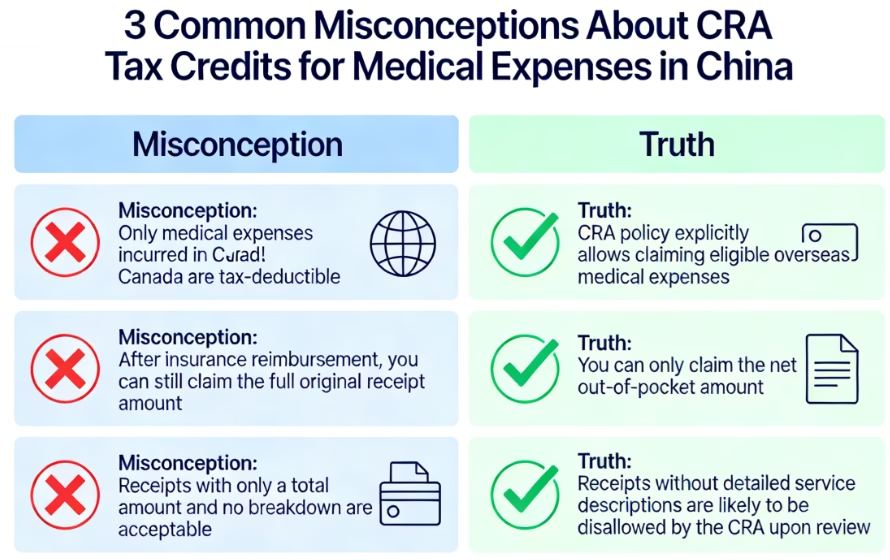
Misconception 1: Only medical expenses incurred in Canada are tax-deductible.
Truth: CRA policy explicitly allows claiming eligible overseas medical expenses. Services provided by legitimate Chinese medical institutions are recognized.
Misconception 2: After insurance reimbursement, you can still claim the full original receipt amount.
Truth: You can only claim the net out-of-pocket amount. Double claiming constitutes tax fraud.
Misconception 3: Receipts with only a total amount and no breakdown are acceptable.
Truth: Receipts without detailed service descriptions are likely to be disallowed by the CRA upon review, leading to a rejected claim.
Frequently Asked Questions (FAQ)
Q: Can health supplements or Chinese herbal medicine purchased in China be claimed?
A: Generally, no. Unless it is a medication prescribed by a doctor to treat a specific disease, ordinary health supplements do not meet the criteria.
Q: Can I claim medical expenses paid for parents visiting China?
A: The conditions are strict. Generally, the parents must be Canadian tax residents during the tax year. Even if they hold a Canadian Permanent Resident (PR) card, expenses paid for short-term visits (non-residents) do not qualify.
Note: “Dependent on you” generally means you provide financial support for necessities of life (such as food, shelter, clothing).
Q: Can all Traditional Chinese Medicine (TCM) treatments (e.g., cupping, massage) be claimed?
A: Not necessarily. Acupuncture may be claimable under specific conditions (performed by a licensed medical practitioner). However, non-therapeutic wellness services like cupping and massage generally do not qualify. Other items require careful assessment; consult a tax advisor.
MedChinaGuide.com: Providing “Medical Care + Tax Compliance” Support
At MedChinaGuide, we are dedicated to providing compliant, worry-free medical services in China for expatriates and assisting you in preparing the necessary documents for tax filing.
Our services ensure:
- Access to Compliant Institutions: We book appointments at international departments of public hospitals and high-end private hospitals in cities like Beijing, Shanghai, Guangzhou, Shenzhen, Chengdu, and Xi’an, ensuring provider qualifications meet requirements.
- Compliant Reimbursement Vouchers: We assist in obtaining clear, itemized invoices (Chinese/English) with official stamps, meeting the CRA’s core requirements for documentation.
- End-to-End Professional Support: From consultation and booking to visit accompaniment and document organization, we provide full English service to clear communication barriers.
- Comprehensive Department Coverage: Covering General Practice, Dental, Ophthalmology, OB/GYN, Orthopedics, Health Checkups, and more.
Conclusion
Obtaining cost-effective medical services in China while reducing net costs through legal tax planning is entirely feasible. The key lies in choosing compliant medical institutions and properly retaining detailed payment vouchers.
Contact a MedChinaGuide consultant today, and let us help you plan an efficient, transparent, and tax-optimized medical journey in China.
Disclaimer: The content of this article is based on public information from the Canada Revenue Agency (CRA) and is for reference only. It does not constitute professional tax or legal advice. Tax laws are complex and subject to change. Before making any filing decisions, we strongly recommend consulting a licensed Canadian accountant or tax lawyer for professional advice tailored to your specific situation.
Reference:
- Canada Revenue Agency (CRA): Line 33099 – Medical expenses for self, spouse or common-law partner, and your children under 18
- CRA: RC4065 Medical Expenses
- CRA: Income Tax Folio S1-F1-C1, Medical Expense Tax Credit